Rectangles, curves, and Klein bottles, related to Status of the smooth rectangular Peg problem
Every Jordan curve has an inscribed rectangle.
Theorem. Nonexistence of an embedded Klein surface [local-0]
Theorem. Nonexistence of an embedded Klein surface [local-0]
No continuous embedding of the Klein surface into . This is a standard result from algebraic topology. Using Alexander duality to compute homology, we produce a contradiction.
Proof. [local-1]
Proof. [local-1]
Given a Jordan curve , the set of unordered and unequal pairs of points in , denoted , is an open Möbius band. Because every unequal unordered pair of points in the circle determines a unique point in : Take the two tangent lines to the circle at these points and intersect them.
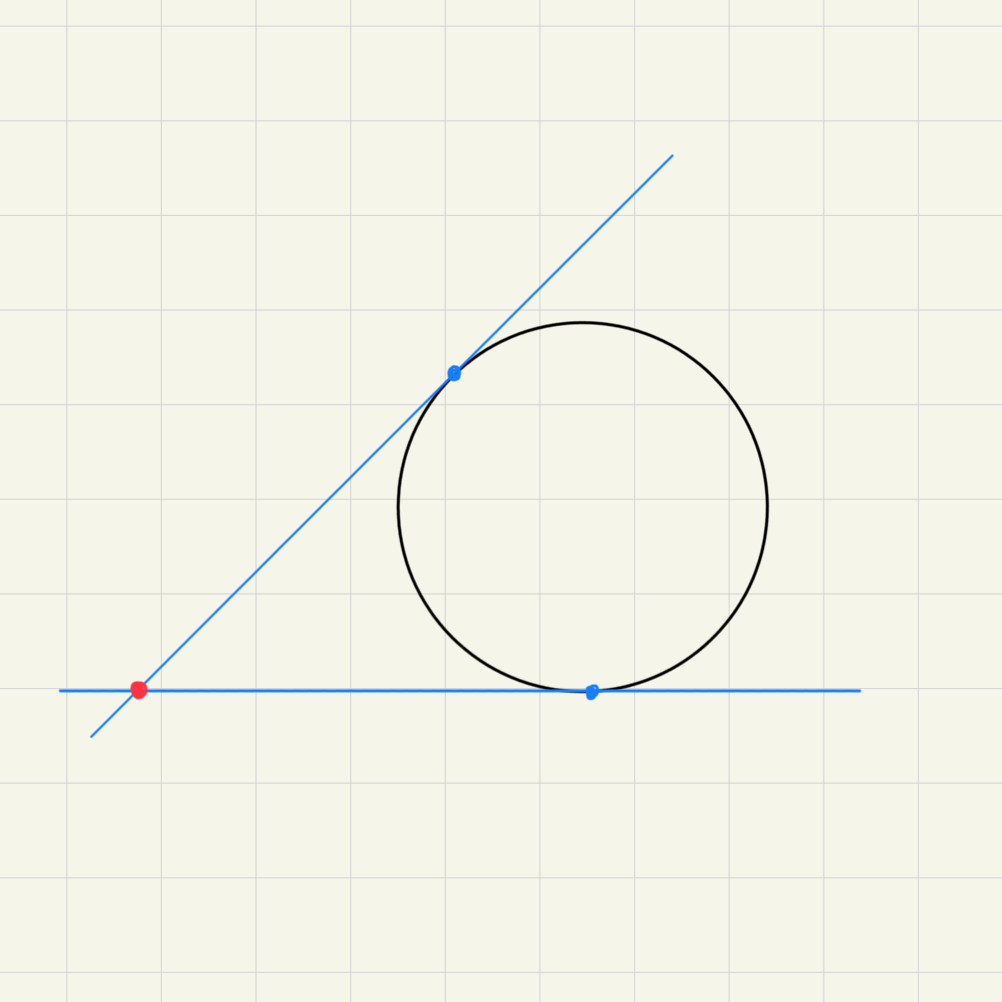
If tangent lines are parallel, than it indicates the infinite point of :
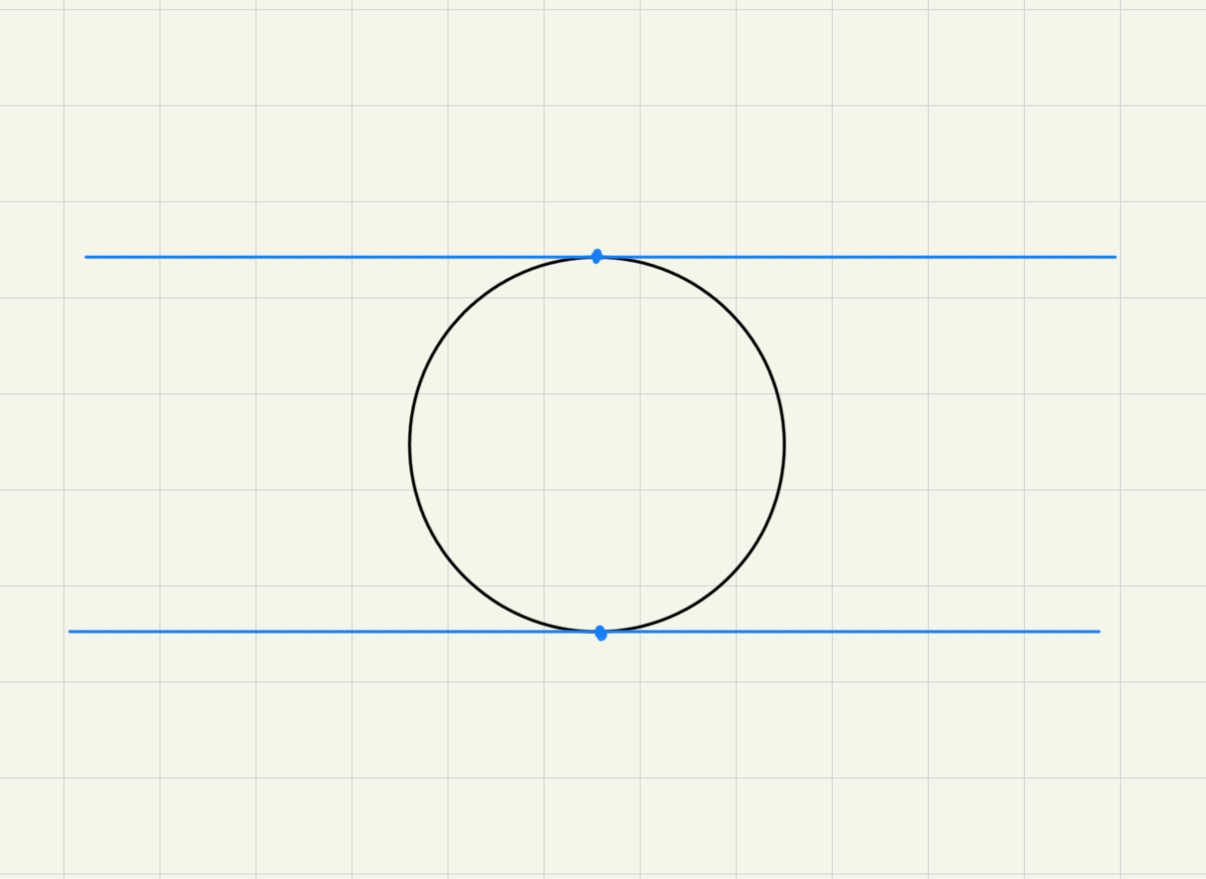
Therefore, are the points of the complement of the closed unit disk in the projective plane, hence an open Möbius band.
Consider a map defined by
Geometrically, maps the ordered pair to a point encoding the midpoint of the segment (2D) and the length of the segment (1D).
If , then these four points form an inscribed rectangle. Hence we just need to prove that the map is not injective!
Consider where reflects the shape in the XY-plane. This is a Klein surface by gluing two Möbius strips at their boundary.
If is injective, then can be embedded into , which contradicts the theorem that nonexistence of an embedded Klein surface into .